
| 1. | According to the information in Figure 1, which of the following cities receives the LEAST percent of possible sunshine? |
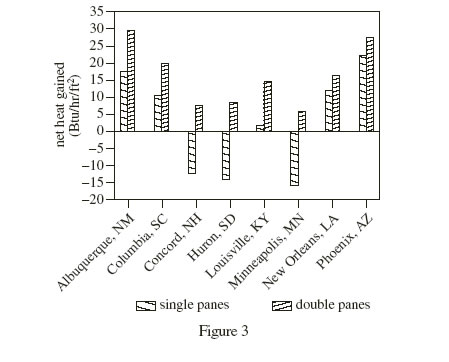
| 2. | According to the information in Figure 3, the greatest heat gained through double-pane glass occurs in which of the following cities? |
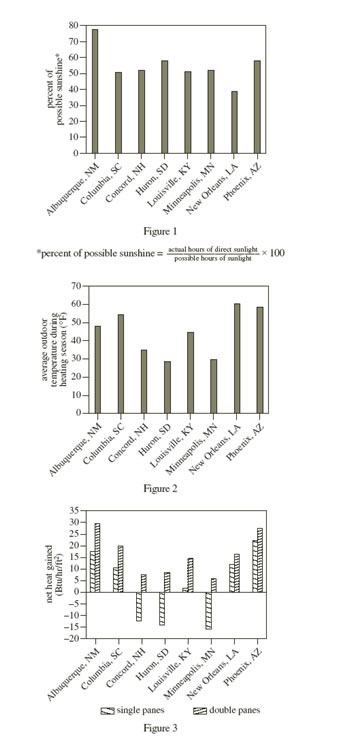
| 3. | According to the data, the greatest net heat loss through a single-pane window occurred in which city? |
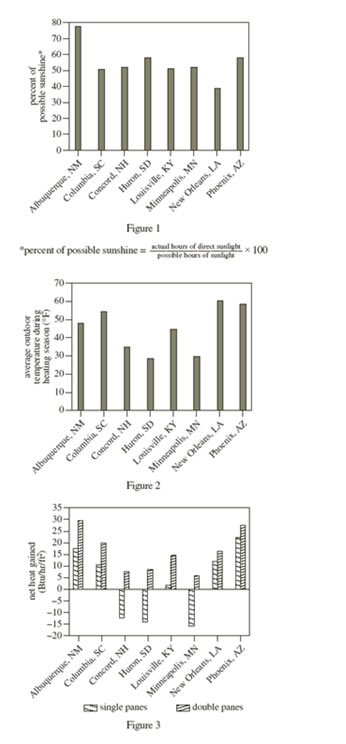
| 4. | Indianapolis, Indiana, receives 51% possible sunshine and has an average temperature of 40.3°F during the heating season. On the basis of the data presented, the net heat gained by a double-pane window in Indianapolis would be approximately: |
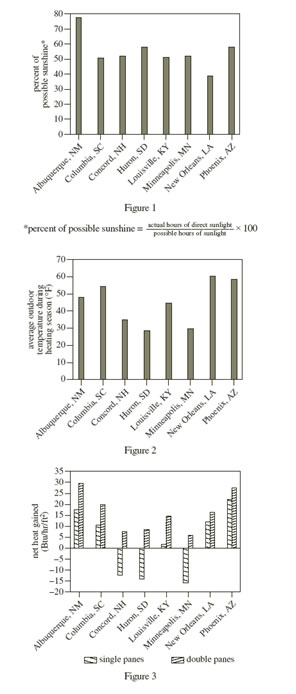
| 5. | Which of the following hypotheses about the relationship between the percent of possible sunshine and average outdoor temperature during the heating season is best supported by the data? |
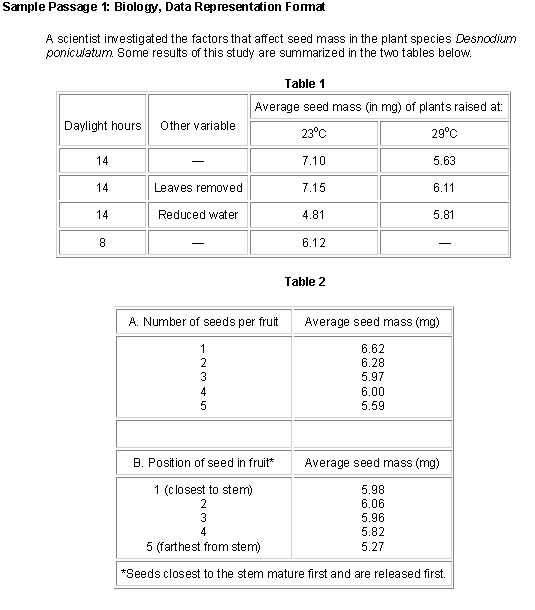
| 6. | The data suggest that subjecting plants to which of the following conditions would result in the greatest seed masses? |

| 7. | Which of the following conclusions is NOT consistent with the data presented in Table 2? |
| 8. | Suppose some of the plants in the study had been exposed to 8 hours of sunlight and a temperature of 29oC. If no other variables were introduced, which of the following would be the most reasonable prediction of the average mass of the seed(s) produced under those circumstances? |
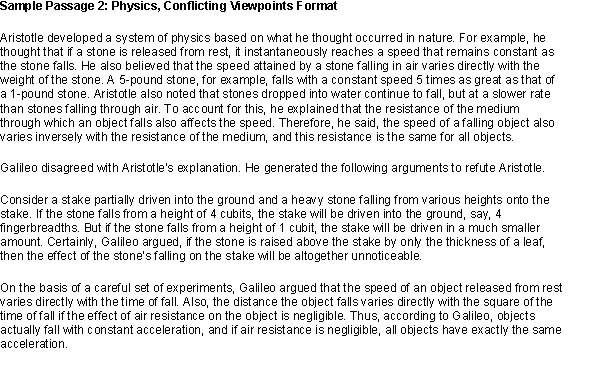
| 9. | Which graph accurately represents Galileo's theory of the relationship between speed and time for an object falling from rest under conditions of negligible air resistance? |
| 10. | A book dropped from a height of 1 meter falls to the floor in t seconds. To be consistent with Aristotle's views, from what height, in meters, should a book 3 times as heavy be dropped so that it will fall to the floor in the same amount of time? |
| 11. | Suppose a heavy object falls to the ground in t seconds when dropped from shoulder height. According to Galileo, if air resistance were negligible, how many seconds would it take an object half as heavy to fall to the ground from the same height? |
| 12. | A piece of putty weighing 2 pounds is dropped down a shaft from the top of a tall building; 1 second later, a 3 pound piece of putty is dropped down the shaft. According to Aristotle, what happens to the 2 pieces of putty if they fall for a relatively long time? |
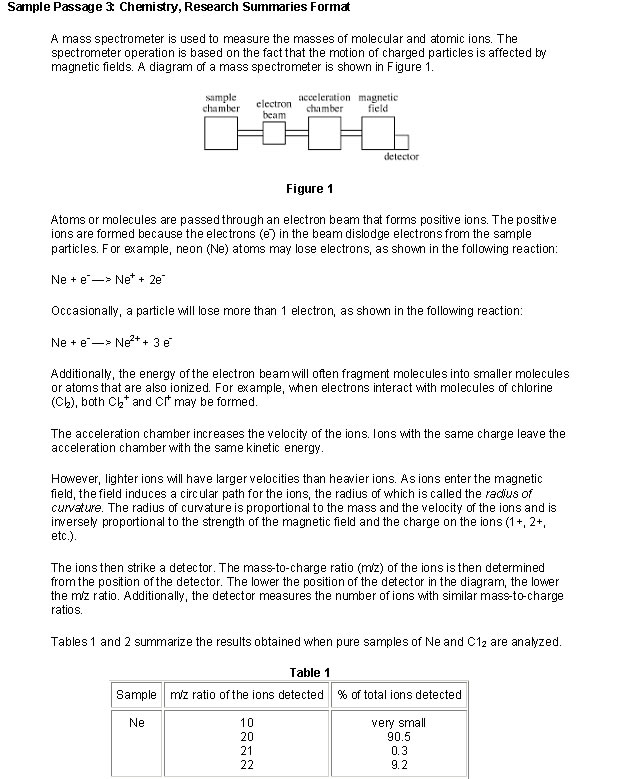
| 13. | The detector on the mass spectrometer shown in Figure 1 would NOT measure the m/z ratios of substances that: |
| 14. | Based on the data in Table 1, a scientist stated that an atom of 20Ne has an atomic mass of 20. In order to make this statement, the scientist assumed that: |
| 15. | If 2 Cl2+ ions are formed from a Cl2 molecule, how many electrons are lost from the original Cl2 molecule? |
| 16. | If the kinetic energy and the velocity of a Cl+ ion were compared to that of a Cl2+ ion, the Cl+ ion would have: |
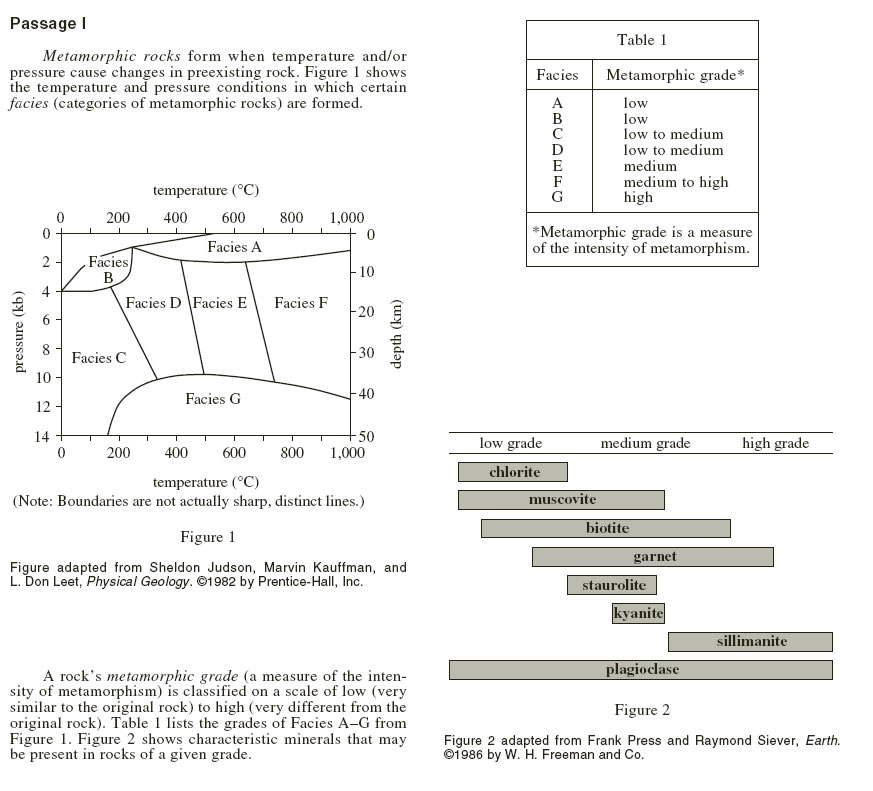
| 17. | According to Figure 2, which of the following minerals would most typically be found only in rocks of a medium grade? |
| 18. | According to Figure 1, a Facies G rock will most likely form under which of the following pressure and temperature conditions? |
| 19. | Figure 1 indicates that as depth increases, pressure: |
| 20. | According to Figure 2, the presence of which of the following minerals in a metamorphic rock would be least helpful in determining that rocks grade? |
| 21. | Hornfels is a metamorphic rock formed when magma (molten rock) heats sedimentary rocks on Earths surface. According to Figure 1, hornfels is most likely a member of which of the following facies? |
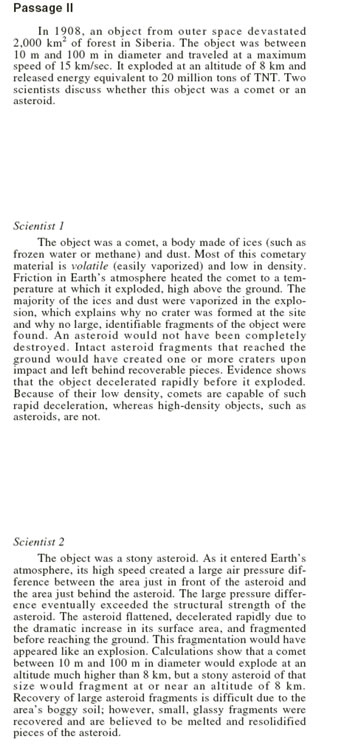
| 22. | Which of the following phrases best describes the major point of difference between the 2 scientists hypotheses? |
| 23. | According to Scientist 2s viewpoint, compared to the altitude at which a stony asteroid would have exploded in Earths atmosphere, a comet of similar size would most likely have exploded at: |
| 24. | Scientist 1s viewpoint indicates that when the materials that compose most of a comet are sufficiently heated, they change to: |
| 25. | Which of the following statements best describes how Scientist 2 would explain why no large, identifiable fragments of the object have been recovered? |
| 26. | How would the behavior of the asteroid differ from that described in Scientist 2s viewpoint if the asteroid had not been flattened by the air pressure difference? The asteroid would: |
| 27. | Which of the following statements would both scientists most likely use to explain the damage to the forest caused by the objects explosion? Energy from the explosion: |
| 28. | Scientist 1s viewpoint would be weakened by which of the following observations about comets, if true? |
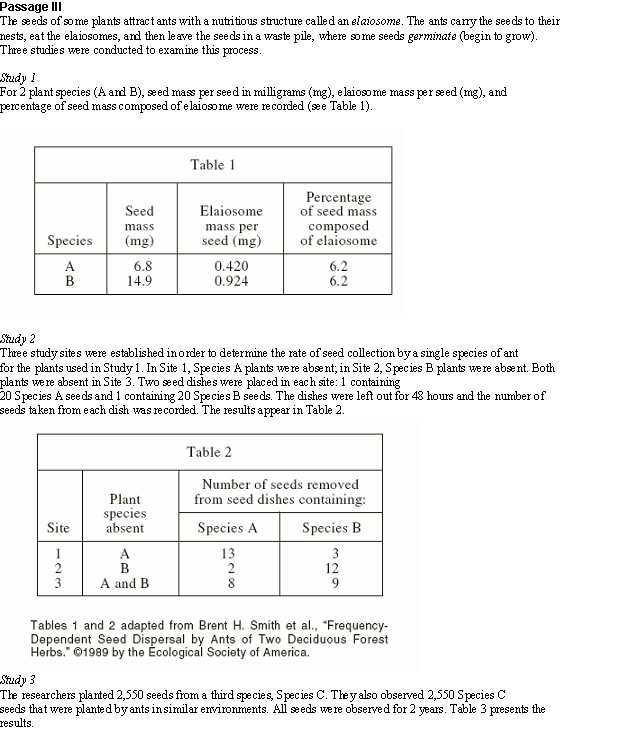
| 29. | Based on the results of Study 3, one could generalize that compared to hand-planting of seeds, ant-planting of seeds results in: |
| 30. | Which of the following variables was controlled in the design of Study 2 ? |
| 31. | According to the results of the studies, Species A and Species B are most similar in that their: |
| 32. | In Study 2, Site 3 was used to study the: |
| 33. | Which of the following is a weakness of the design of Study 2 ? |
| 34. | The results of Study 2 suggest that which of the following factors most affects the seed preference of ants? |

| 35. | The results of the 2 experiments support the conclusion that, for a given brand of tape, as the tapes width increases, the force required to remove the tape from a given wrapping: |
| 36. | In Experiment 2, had Brand X tape in a 4.0 cm width been tested, the force required to remove the tape from the plastic wrapping would have been closest to: |
| 37. | Based on the average results of Experiments 1 and 2, which of the following brands of tape adhered better to the paper than to the plastic? |
| 38. | Which brand(s) of tape was/were used at only 2 different widths in both experiments? |
| 39. | For the students to determine the force required to remove tape from a wrapping, which of the following attractive forces had to exceed the adhesive force between the tape and the wrapping? |
| 40. | The students instructor gave them a strip of tape that was 2.5 cm wide and asked them to identify the brand. The students repeated the procedures from Experiments 1 and 2 using the tape and obtained average forces of 4.9 N for paper and 4.1 N for plastic. Which of the following brands would most likely have produced these results? |
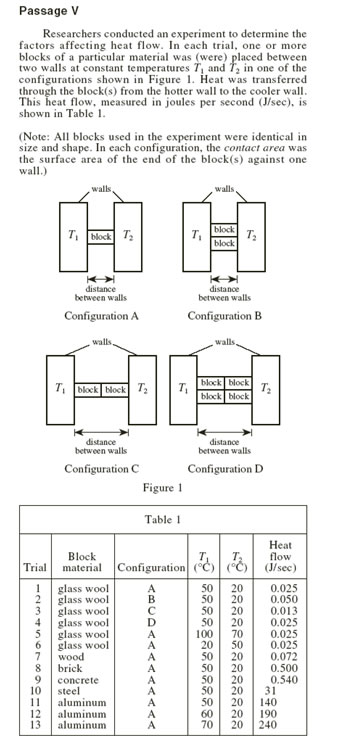
| 41. | According to the information provided, heat flowed from the wall at temperature T2 to the wall at temperature T1 in which trial? |
| 42. | Insulators are materials that are poor heat conductors. According to Trials 7 through 10, a wall of a given thickness built of which of the following materials would provide the best insulation between a room and the outdoors? |
| 43. | The results of Trials 1 and 5 are consistent with the hypothesis that heat flow from a hotter wall to a cooler wall is dependent on the: |
| 44. | Materials differ in their thermal conductivities: the higher the thermal conductivity, the greater the heat flow through the material. According to Trials 6 through 11, which of the following statements about relative thermal conductivities is NOT true? |
| 45. | Trials 1 and 3 provide evidence that heat flow depends on which of the following factors? |
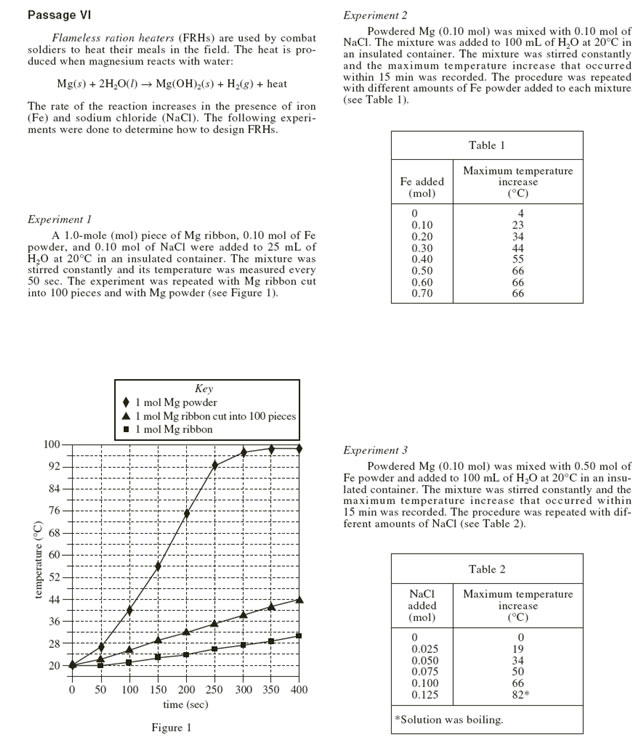
| 46. | Which of the following is the most likely reason that amounts greater than 0.125 mol of NaCl were not tested in Experiment 3 ? The results showed that: |
| 47. | Based on the results of Experiment 3, one can reasonably conclude that as the amount of NaCl added increased from 0 mol to 0.100 mol, the maximum rise in temperature within 15 min of the start of the reaction: |
| 48. | If a trial had been done in Experiment 3 with 0.060 mol of NaCl added, the maximum temperature increase of the mixture that would have occurred within 15 min would have been closest to: |
| 49. | Which of the following factors affecting the reaction of Mg and H2O was studied in Experiment 1, but not in Experiments 2 or 3 ? |
| 50. | An engineer is designing an FRH, to be used with 100 mL of H2O, that will most rapidly generate the greatest amount of heat with the least amount of materials. Based on the results of Experiments 1, 2, and 3, which of the following specifications should she choose? |
| 51. | It has been observed that as Mg and H2O react, the Mg(OH)2 (magnesium hydroxide) that is produced forms an unreactive coating on the Mg surface. Which of the following models for why NaCl speeds up the reaction is most consistent with this observation and the results of the experiments? |
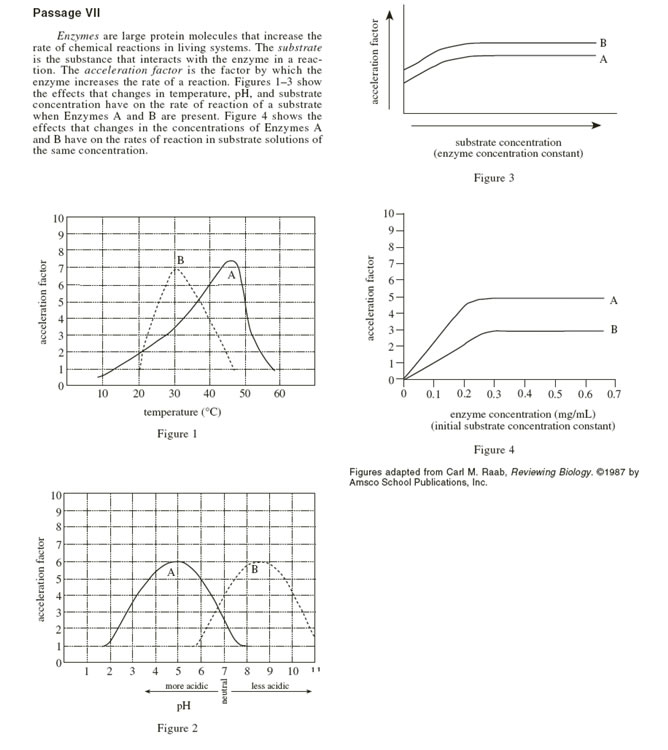
| 52. | According to Figure 2, Enzyme A has the fastest rate of reaction at a pH closest to: |
| 53. | Based on the data in Figure 2, at which of the following pHs, if any, do Enzymes A and B have the same acceleration factor? |
| 54. | A scientist claims that the acceleration factor of Enzyme B is dependent on both enzyme and substrate concentration. Do the data in Figures 3 and 4 support her claim? |
| 55. | A scientist claims that for the conditions used to obtain the data for Figure 4, the acceleration factor of Enzyme B at a given concentration will always be greater than that of Enzyme A at the same concentration. Do the data support his conclusion? |
| 56. | The figure below shows the relative acceleration factors for pepsin, an enzyme found in the stomach, and trypsin, an enzyme found in the small intestine. Based on this figure and Figure 2, one would best conclude that compared to the acidity of solutions in the stomach, the solutions in the small intestine are: |
| 1. | According to the information in Figure 1, which of the following cities receives the LEAST percent of possible sunshine? |
| 2. | According to the information in Figure 3, the greatest heat gained through double-pane glass occurs in which of the following cities? |
| 3. | According to the data, the greatest net heat loss through a single-pane window occurred in which city? |
| 4. | Indianapolis, Indiana, receives 51% possible sunshine and has an average temperature of 40.3°F during the heating season. On the basis of the data presented, the net heat gained by a double-pane window in Indianapolis would be approximately: |
| 5. | Which of the following hypotheses about the relationship between the percent of possible sunshine and average outdoor temperature during the heating season is best supported by the data? |
| 6. | The data suggest that subjecting plants to which of the following conditions would result in the greatest seed masses? |
| 7. | Which of the following conclusions is NOT consistent with the data presented in Table 2? |
| 8. | Suppose some of the plants in the study had been exposed to 8 hours of sunlight and a temperature of 29oC. If no other variables were introduced, which of the following would be the most reasonable prediction of the average mass of the seed(s) produced under those circumstances? |
| 9. | Which graph accurately represents Galileo's theory of the relationship between speed and time for an object falling from rest under conditions of negligible air resistance? |
| 10. | A book dropped from a height of 1 meter falls to the floor in t seconds. To be consistent with Aristotle's views, from what height, in meters, should a book 3 times as heavy be dropped so that it will fall to the floor in the same amount of time? |
| 11. | Suppose a heavy object falls to the ground in t seconds when dropped from shoulder height. According to Galileo, if air resistance were negligible, how many seconds would it take an object half as heavy to fall to the ground from the same height? |
| 12. | A piece of putty weighing 2 pounds is dropped down a shaft from the top of a tall building; 1 second later, a 3 pound piece of putty is dropped down the shaft. According to Aristotle, what happens to the 2 pieces of putty if they fall for a relatively long time? |
| 13. | The detector on the mass spectrometer shown in Figure 1 would NOT measure the m/z ratios of substances that: |
| 14. | Based on the data in Table 1, a scientist stated that an atom of 20Ne has an atomic mass of 20. In order to make this statement, the scientist assumed that: |
| 15. | If 2 Cl2+ ions are formed from a Cl2 molecule, how many electrons are lost from the original Cl2 molecule? |
| 16. | If the kinetic energy and the velocity of a Cl+ ion were compared to that of a Cl2+ ion, the Cl+ ion would have: |
| 17. | According to Figure 2, which of the following minerals would most typically be found only in rocks of a medium grade? |
| 18. | According to Figure 1, a Facies G rock will most likely form under which of the following pressure and temperature conditions? |
| 19. | Figure 1 indicates that as depth increases, pressure: |
| 20. | According to Figure 2, the presence of which of the following minerals in a metamorphic rock would be least helpful in determining that rocks grade? |
| 21. | Hornfels is a metamorphic rock formed when magma (molten rock) heats sedimentary rocks on Earths surface. According to Figure 1, hornfels is most likely a member of which of the following facies? |
| 22. | Which of the following phrases best describes the major point of difference between the 2 scientists hypotheses? |
| 23. | According to Scientist 2s viewpoint, compared to the altitude at which a stony asteroid would have exploded in Earths atmosphere, a comet of similar size would most likely have exploded at: |
| 24. | Scientist 1s viewpoint indicates that when the materials that compose most of a comet are sufficiently heated, they change to: |
| 25. | Which of the following statements best describes how Scientist 2 would explain why no large, identifiable fragments of the object have been recovered? |
| 26. | How would the behavior of the asteroid differ from that described in Scientist 2s viewpoint if the asteroid had not been flattened by the air pressure difference? The asteroid would: |
| 27. | Which of the following statements would both scientists most likely use to explain the damage to the forest caused by the objects explosion? Energy from the explosion: |
| 28. | Scientist 1s viewpoint would be weakened by which of the following observations about comets, if true? |
| 29. | Based on the results of Study 3, one could generalize that compared to hand-planting of seeds, ant-planting of seeds results in: |
| 30. | Which of the following variables was controlled in the design of Study 2 ? |
| 31. | According to the results of the studies, Species A and Species B are most similar in that their: |
| 32. | In Study 2, Site 3 was used to study the: |
| 33. | Which of the following is a weakness of the design of Study 2 ? |
| 34. | The results of Study 2 suggest that which of the following factors most affects the seed preference of ants? |
| 35. | The results of the 2 experiments support the conclusion that, for a given brand of tape, as the tapes width increases, the force required to remove the tape from a given wrapping: |
| 36. | In Experiment 2, had Brand X tape in a 4.0 cm width been tested, the force required to remove the tape from the plastic wrapping would have been closest to: |
| 37. | Based on the average results of Experiments 1 and 2, which of the following brands of tape adhered better to the paper than to the plastic? |
| 38. | Which brand(s) of tape was/were used at only 2 different widths in both experiments? |
| 39. | For the students to determine the force required to remove tape from a wrapping, which of the following attractive forces had to exceed the adhesive force between the tape and the wrapping? |
| 40. | The students instructor gave them a strip of tape that was 2.5 cm wide and asked them to identify the brand. The students repeated the procedures from Experiments 1 and 2 using the tape and obtained average forces of 4.9 N for paper and 4.1 N for plastic. Which of the following brands would most likely have produced these results? |
| 41. | According to the information provided, heat flowed from the wall at temperature T2 to the wall at temperature T1 in which trial? |
| 42. | Insulators are materials that are poor heat conductors. According to Trials 7 through 10, a wall of a given thickness built of which of the following materials would provide the best insulation between a room and the outdoors? |
| 43. | The results of Trials 1 and 5 are consistent with the hypothesis that heat flow from a hotter wall to a cooler wall is dependent on the: |
| 44. | Materials differ in their thermal conductivities: the higher the thermal conductivity, the greater the heat flow through the material. According to Trials 6 through 11, which of the following statements about relative thermal conductivities is NOT true? |
| 45. | Trials 1 and 3 provide evidence that heat flow depends on which of the following factors? |
| 46. | Which of the following is the most likely reason that amounts greater than 0.125 mol of NaCl were not tested in Experiment 3 ? The results showed that: |
| 47. | Based on the results of Experiment 3, one can reasonably conclude that as the amount of NaCl added increased from 0 mol to 0.100 mol, the maximum rise in temperature within 15 min of the start of the reaction: |
| 48. | If a trial had been done in Experiment 3 with 0.060 mol of NaCl added, the maximum temperature increase of the mixture that would have occurred within 15 min would have been closest to: |
| 49. | Which of the following factors affecting the reaction of Mg and H2O was studied in Experiment 1, but not in Experiments 2 or 3 ? |
| 50. | An engineer is designing an FRH, to be used with 100 mL of H2O, that will most rapidly generate the greatest amount of heat with the least amount of materials. Based on the results of Experiments 1, 2, and 3, which of the following specifications should she choose? |
| 51. | It has been observed that as Mg and H2O react, the Mg(OH)2 (magnesium hydroxide) that is produced forms an unreactive coating on the Mg surface. Which of the following models for why NaCl speeds up the reaction is most consistent with this observation and the results of the experiments? |
| 52. | According to Figure 2, Enzyme A has the fastest rate of reaction at a pH closest to: |
| 53. | Based on the data in Figure 2, at which of the following pHs, if any, do Enzymes A and B have the same acceleration factor? |
| 54. | A scientist claims that the acceleration factor of Enzyme B is dependent on both enzyme and substrate concentration. Do the data in Figures 3 and 4 support her claim? |
| 55. | A scientist claims that for the conditions used to obtain the data for Figure 4, the acceleration factor of Enzyme B at a given concentration will always be greater than that of Enzyme A at the same concentration. Do the data support his conclusion? |
| 56. | The figure below shows the relative acceleration factors for pepsin, an enzyme found in the stomach, and trypsin, an enzyme found in the small intestine. Based on this figure and Figure 2, one would best conclude that compared to the acidity of solutions in the stomach, the solutions in the small intestine are: |